
| Classification: | Reference: | Date: |
| EC20-029A | NTB20-089A | April, 13 2021 |
VOLUNTARY SAFETY/EMISSION RECALL CAMPAIGN
2020 TITAN AND TITAN XD; EGI HARNESS
This bulletin has been amended. See AMENDMENT HISTORY on the last page. Discard all previous versions of this bulletin.
| CAMPAIGN ID #: | PC773 |
| APPLIED VEHICLES: | 2020 Titan and Titan XD (A61) |
| APPLIED ENGINE: | VK56VD (Gasoline V8) |
Check Service COMM or Dealer Business Systems (DBS) National Service History to confirm campaign eligibility.
INTRODUCTION
Nissan is conducting this voluntary safety and emission recall campaign on certain specific model year 2020 Titan and Titan XD vehicles to repair the engine control (EGI) harness. If visible damage is found, during the repair, the entire harness must be replaced instead. This service will be performed at no charge to the customer for parts or labor.
IDENTIFICATION NUMBER
Nissan has assigned identification number PC773 to this campaign. This number must appear on all communication and documentation of any nature dealing with this campaign.
DEALER RESPONSIBILITY
It is the dealer’s responsibility to check Service COMM or Dealer Business Systems (DBS) National Service History for the campaign status on each vehicle falling within the range of this voluntary safety and emission recall which for any reason enters the service department. This includes vehicles purchased from private parties or presented by transient (tourist) owners and vehicles in a dealer’s inventory. Federal law requires that new vehicles in dealer inventory which are the subject of a safety recall must be corrected prior to sale. Failure to do so can result in civil penalties by the National Highway Traffic Safety Administration. While federal law applies only to new vehicles, Nissan strongly encourages dealers to correct any used vehicles in their inventory before they are retailed.
IMPORTANT
Attention California Dealers
An Emission Recall Campaign Completion (ERCC) label must be filled out by the technician performing the repair, and then attached to the underside of the vehicle hood. A sample of the label is shown below.
California law prohibits owners from renewing their California registration if emissions related recall work has not been performed. California dealers are now required to issue a proof of correction certificate to vehicle owners upon completion of emissions related recall work. Please fill out one of the campaign completion forms for each owner that has this campaign performed. Instruct owners to keep this certificate unless they are requested to mail it to the
NOTE:
- These forms (item number CAEMRC 1-20) and labels (item number NIS-UHL-16) are available from Nissan Publications (1-800-247-5321) at no charge.
- When either item (form or label) is ordered, you will automatically receive the other item as well.
REPAIR OVERVIEW
Check Service COMM campaign ID # PC773 to confirm
the vehicle you are working on requires this campaign
↓
Repair Preparation
↓
EGI Harness Disassembly
↓
Transmission Power Supply Splice Repair
↓
Continuity Check
↓
Harness Reassembly
↓
Check and Erase DTCs
↓
End
SERVICE PROCEDURE
NOTICE
To avoid damage to the vehicle, if there is VISIBLE DAMAGE to any of the individual wires within the EGI harness, the entire harness must be replaced.
Repair Preparation
- Write down the radio presets.
- Disconnect the 12V battery.
- Disconnect the negative battery cable first.
- Remove the positive battery terminal cover and disconnect the positive battery cable.
- Place suitable covers on both fenders and across the front of the vehicle to prevent damage to the vehicle’s finish.
- Remove the engine cover.
a. Pull up on the front corners of the engine cover to release it.
b. While lifting, pull the cover toward the front of the vehicle to disengage the rear of the cover.
c. Place the engine cover in a clean area.
EGI Harness Disassembly
NOTE: The EGI harness repair will be performed toward the back of the passenger side valve cover, as shown in Figure 6.
- Remove the EGI harness from the harness retainer clip as shown in Figure 7.
- Disengage the harness retainer by inserting a small flat blade screwdriver and gently prying outward to disengage.
- Disengage the harness retainer as shown in Figure 8.
a. Depress both sides of the harness retainer clip to disengage.
b. With the retainer clip tabs disengaged, push the harness toward the rear of the vehicle to remove it from the harness retainer bracket.
- Lift the harness over the harness retainer bracket, as shown in Figure 9, and move the harness toward the front of the vehicle.
- Carefully move the heater hose, shown in Figure 10, down and hook it behind the EGI harness retainer bracket to allow unobstructed access to the EGI harness.
- Using a suitable tool, remove and discard the banded harness retainer shown in Figure 11.
- The banded harness retainer will be replaced during reassembly.
NOTICE
To avoid damage to the harness, do NOT use a sharp cutting tool to remove the vinyl tape.
- Carefully remove the vinyl tape to expose the area above the rubber harness protector, shown in Figure 12.
- Carefully roll the end of the rubber harness protector, and then pull it in the direction shown in Figure 13 to expose the foam insulator and the tape securing the mesh harness protector.
NOTICE
To avoid damage to the harness, do NOT use a sharp cutting tool to remove the foam insulator.
- Carefully remove the foam insulator and the tape that it is attached to. Refer to Figure 14 and Figure 15.
- To expose the harness, carefully move the mesh harness protector toward the back of the engine, as shown in Figure 16.
NOTICE
To avoid damage to the harness, do NOT use a sharp cutting tool to remove the vinyl tape.
- Carefully remove the vinyl tape that bundles the harness together.
- Identify the transmission power supply wire for repair.
- The transmission power supply wire is located near the center of the EGI harness.
- The transmission power supply wire is completely wrapped with vinyl tape.
- Locate the affected splice within the transmission power supply wire.
- The splice will be located near the large harness retaining clip.
- The splice can be located by feeling for a raised section on the wire.
NOTICE
To avoid damage to the harness, do NOT use a sharp cutting tool to remove the vinyl tape.
- Carefully tear and unravel part of the vinyl tape to expose the blue aluminum-shielding tape.
- Carefully remove the blue aluminum-shielding tape from the harness to expose the splice.
- The entire splice and part of the red wire insulation MUST be exposed.
Transmission Power Supply Splice Repair
NOTE: Refer to the parts information section to become familiar with the contents of the EGI harness repair kit.
- Separate the bare ground drain wire from the splice (Figure 22).
- Cover the splice with the butyl strips (M4117008), while making sure the bare drain wire is NOT covered with the butyl.
a. Center the first butyl strip onto the splice as shown in Figure 23.
b. Press the butyl strip onto the splice and remove the backing.
c. Center the second butyl strip onto the uncovered portion of the splice.
d. Press the butyl strips together around the splice.
e. Remove the backing from the second butyl strip.
f. Verify the entire splice is covered, as shown in Figure 24.
NOTICE
To avoid damage to the vehicle, ensure the bare ground drain wire is NOT covered by the butyl strips.
- Carefully wrap a 4.5-inch long section of the black splice tape (M0537401) horizontally around the butyl making sure all of the butyl is covered.
- Verify the bare ground drain wire is outside of the splice tape as shown in Figure 25.
- Wrap the transmission power supply wire and bare ground drain wire with the aluminum tape (M2173004-3M).
a. Place the bare ground drain wire against the transmission power supply wire.
b. Begin by wrapping the aluminum tape over the vinyl tape that was not removed during the repair.
c. Making sure the blue side is visible, wrap the aluminum tape around the transmission power supply wire and the bare ground drain wire (Figure 26).
d. Wrap the aluminum tape making sure to overlap it with each wrap.
e. Ensure the repair area is completely overlapped with the new aluminum tape.
- Wrap a 3-inch strip of the narrow black vinyl tape (M4042002) around the end of the aluminum tape to prevent it from unravelling.
Perform Continuity Check
- Disconnect the transmission power supply connector, F127, from the positive battery fusible link as shown in Figure 28.
NOTICE
To avoid damage to the F127 connector terminal, only back probe the connector terminal, using the positive meter lead (Figure 29).
- Using a DVOM, backprobe connector F127 and check for continuity to the negative battery cable (Figure 30).
- If there is no continuity, continue to step 26 on page 16.
- If continuity exists, remove the blue aluminum tape and verify the bare ground drain wire is NOT covered by the butyl and recheck for continuity.
-
- Once it is verified that continuity does not exist, rewrap the transmission power supply wire and the bare ground drain wire as stated in step 22 on page 14, then continue to step 26 on page 16.
Harness Reassembly
- Wrap the repair area with the black non-adhesive vinyl tape (M4515102).
- Completely cover the repair area making sure to overlap the tape not removed during the repair.
- Wrap a 3-inch strip of the narrow black vinyl tape (M4042002) around the end of the non-adhesive vinyl tape to prevent it from unravelling.
- Tightly bundle the harness together by hand and wrap the harness with the narrow vinyl tape (M4042002) to hold it together.
- Place the mesh harness protector over the wires (Figure 33).
- While holding the mesh harness protector in place, wrap the end of the mesh with the wide vinyl tape (M2306001) as shown in Figure 34.
- Install the new foam insulator (13535124).
- Remove the backing from the foam insulator.
IMPORTANT: When installing the foam insulator, it cannot be removed. Make sure the position of the foam insulator is correct the first time.
- Move the rubber harness protector tongue over the mesh harness protector.
- Secure the rubber harness protector tongue to the mesh harness protector using the narrow black vinyl tape (M4042002).
- Move the heater hose to its original position.
- Move the harness back into place, over the harness retainer bracket.
- Install the harness into the large harness retainer and lock it into place as shown in Figure 38.
- Install a new banded harness retainer from the repair kit onto the harness and attach it to the retainer bracket.
- Tighten the band after attaching it to the retainer bracket.
- Trim the excess band.
- Reinstall the engine cover.
- Reconnect the transmission power supply connector, F127, to the fusible link.
- Reconnect the positive battery cable.
- Torque the positive battery terminal nut to 5.5 N●m (48 in-lb).
- Torque the fusible link box nuts on the top of the positive battery terminal to 5 N●m (120 in-lb).
- Reinstall the positive battery terminal cover.
- Reconnect the negative battery cable.
- Torque the negative battery terminal nut to 5.35 N●m (47 in-lb).
- Remove the fender covers.
- Reset the clock and the radio settings.
Check and Erase DTCs
- Connect the CONSULT PC to the vehicle.
- Start C-III plus.
- Wait for the VI to be recognized.
- Select Diagnosis (All Systems).
- Select Automatic Selection(VIN).
- Confirm the VIN, Vehicle Name, and Model Year are correct, then select Confirm.
- Select ERASE.
- Select Execute.
- Select Close.
- Close C-III plus.
- Turn the ignition OFF.
- Remove the VI.
PARTS INFORMATION
| DESCRIPTION | PART NUMBER | QUANTITY |
| EGI HARNESS REPAIR KIT | 240R2-9FV0B | 1 |
CLAIMS INFORMATION
Submit a “CM” line claim using the following claims coding:
| CAMPAIGN (“CM”) ID | DESCRIPTION | OP CODE | FRT |
| PC773 | Repair EGI harness | PC7730 | 1.2 hrs |
| Replace EGI harness | Contact Warranty Call Center | ||
AMENDMENT HISTORY
| PUBLISHED DATE | REFERENCE | DESCRIPTION |
| December 8, 2020 | NTB20-089 | Original bulletin published |
| April 13, 2021 | NTB20-089A | Updated campaign type to safety and emission recall, Emission Recall Campaign Completion label information added. |
Remedy Instructions and TSB
NTB20-089A
April, 13 2021
RCRIT-20V759-1875.pdf 5459.047KB
Remedy Instructions and TSB
NTB20-089
December 8, 2020
RCRIT-20V759-6213.pdf 5287.485KB
Latest Recalls Documents

- Widely application: The material of wire harness cloth tape is soft and corrosion-resistant, which is suitable for the use of wire harness in automobile interior noise reduction part, such as wire harness of the dashboard, main harness wound and applied for wire joint and wire fixing; It can also sort out home appliance wiring and more
- Easy to tear: Just stick one end of tape to cable, start pulling and wrapping onto the cable and tear it gently; No need scissors and other tools; You can decide the length of the wire cloth tape according to you needs
- Professional cloth tape material: It is made of polyester non-woven fabric and strong acrylic pressure sensitive adhesive; High viscosity, high temperature resistance ( -40°F to 221°F ), well seal and excellent flexibility
- Excellent performance: The wiring harness tape maintains features good noise reduction, hand tearable and heat insulation performance, and wear resistance; It is suitable for electrical automotive engine and circuit maintenance to achieve the purpose of insulation protection
- Specification: A set of 5 rolls wire harness cloth tap; SIZE: Each roll black electrical harness tape is 50 FT long and 3/4 inch wide; It is work for your different daily needs in diversified use scenarios

- High temp Wire Harness Automotive Cloth Tape with excellent sound and rattle dampening performance. Lessens coil whining and lasts well against elevated temperatures (-40℉ - 257℉).
- Sports a race-spec heavy-duty bundling performance but cleanly tears with just bare hands, EMPOWERING average car owners with LITTLE TO NO EXPERIENCE in automotive maintenance to achieve PROFESSIONAL-GRADE results in function and form.
- This Wire Loom Tape features an extremely strong adhesive but does not turn into a messy goo. Rated to last up to 6 years and can easily get you through 150k miles of mileage.
- Its bi-directional weave makes it puncture-resistant and abrasion and corrosion-resistant. This automotive felt tape preserves cables in their pristine condition.
- This engine tape wrap is similar, if not better, in thickness, tensile strength and looks with OEM wire harness tapes. Extra-sticky adhesive enables users to bundle hard-to-reach cables quickly.

- High temp Wire Harness Automotive Cloth Tape with excellent sound and rattle dampening performance. Lessens coil whining and lasts well against elevated temperatures (-40℉ - 257℉).
- Sports a race-spec heavy-duty bundling performance but cleanly tears with just bare hands, EMPOWERING average car owners with LITTLE TO NO EXPERIENCE in automotive maintenance to achieve PROFESSIONAL-GRADE results in function and form.
- This Wire Loom Tape features an extremely strong adhesive but does not turn into a messy goo. Rated to last up to 6 years and can easily get you through 150k miles of mileage.
- Its bi-directional weave makes it puncture-resistant and abrasion and corrosion-resistant. This automotive felt tape preserves cables in their pristine condition.
- This engine tape wrap is similar, if not better, in thickness, tensile strength and looks with OEM wire harness tapes. Extra-sticky adhesive enables users to bundle hard-to-reach cables quickly.
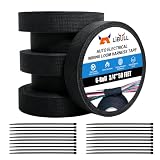
- Extreme-temperature resistant & Noise/Vibration Reduction: The high temp automotive fabric wiring harness tape withstands a wide temperature range from -40°F to 257°F and offers excellent flame-retardant performance — flame will self-extinguish within 30s. It effectively reduces rattling, vibrations, and noise inside the vehicle or within electrical components. Additionally, its wear-resistant properties enhance cable durability.
- Durable Materials: Made from polyester non-woven fabric and strong pressure-sensitive acrylic adhesive, this cloth electrical tape automotive provides excellent sealing and flexibility. Its adhesion strengthens over time and lasts up to 6 years. Plus, it removes cleanly with no solvent residue, leaving surfaces spotless. Suitable for both home and industrial use.
- Wide Applications: The fabric electrical tape for virtually any wiring job — from automotive harnesses (engine compartment, dashboard, doors, roof, chassis, bumper, trunk) to home appliances (AC, fridge, washer, computer), industrial equipment, and even daily DIY repairs.
- Easy to Tear: Just wrap the cloth wire harness tape around the cable, stretch it to the desired length, and then simply tear it off with your hands. No need for any additional tools, and you can achieve a clean and quick wire harness wrap.
- Specification: Each roll measures of high temp electrical tape is 50 ft x 3/4 in. Available in 2-pack, 4-pack(with 10 cable ties), 6-pack(with 20 cable ties), or 11-pack(with 40 cable ties). Black blends seamlessly with engine bays and electronic setups. Professional-grade thickness ensures reliable insulation and wear resistance. Stock up for multiple cars or ongoing DIY projects.
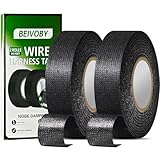
- High Temperature Resistance: Wire harness automotive cloth tape capable of withstanding harsh temperatures (-40 to 250) while delivering excellent soundproofing and vibration dampening
- OEM-Grade Quality: This engine tape wrap matches or exceeds OEM wire harness tapes in thickness, tensile strength, and appearance, with extra-sticky adhesive for quick bundling of hard-to-reach cables
- Easy Hand-Tear Application: Apply this wire loom tape to cables easily without scissors - simply tear it by hand, and its flexible nature makes adjusting the length a breeze
- Puncture and Abrasion Resistance: This automotive felt tape resists abrasions and corrosion, preserving cables in pristine condition
- Versatile Usage: Cloth electrical tape suitable for automotive use and also serves as an excellent tool for organizing appliance cords and household wiring
This product presentation was made with AAWP plugin.