
| Classification: | Reference: | Date: |
| FA21-008B | ITB21-018B | October 5, 2021 |
VOLUNTARY SAFETY RECALL CAMPAIGN
2021 QX50; KNUCKLE INSPECTION
This bulletin has been amended. See AMENDMENT HISTORY on the last page. Discard all previous versions of this bulletin.
| CAMPAIGN ID #: | R21A5 |
| APPLIED VEHICLE: | 2021 QX50 (J55) |
Check Service COMM or Dealer Business Systems (DBS) National Service History to confirm campaign eligibility.
INTRODUCTION
Infiniti is conducting this voluntary safety recall campaign on certain specific model year 2021 QX50 vehicles to inspect and, if necessary, replace the front steering knuckles and rear suspension knuckles. This service will be performed at no charge to the client for parts or labor.
IDENTIFICATION NUMBER
Infiniti has assigned identification number R21A5 to this campaign. This number must appear on all communication and documentation of any nature dealing with this campaign.
RETAILER RESPONSIBILITY
It is the retailer’s responsibility to check Service COMM or Dealer Business Systems (DBS) National Service History for the campaign status on each vehicle falling within the range of this voluntary safety recall which for any reason enters the service department. This includes vehicles purchased from private parties or presented by transient (tourist) owners and vehicles in a retailer’s inventory. Federal law requires that new vehicles in retailer inventory which are the subject of a safety recall must be corrected prior to sale. Failure to do so can result in civil penalties by the National Highway Traffic Safety Administration. While federal law applies only to new vehicles, Infiniti strongly encourages retailers to correct any used vehicles in their inventory before they are retailed.
SERVICE PROCEDURE
WARNING
To avoid the risk of death or severe personal injury, do not reuse single use parts noted in this TSB. Reusing a single use part may induce risk that it, or the component that it secures, may become loose.
Remove the Front Knuckle
- Place the vehicle on a lift and raise to a suitable height.
- Remove both front wheel and tire assemblies.
- Remove the front wheel speed sensor bolt (10 mm) from the steering knuckle (Figure 1).
- Remove the front wheel speed sensor harness bracket bolt (10 mm) from the steering knuckle.
- Separate the front wheel speed sensor harness grommets from the front wheel speed sensor harness bracket (Figure 2).
- Separate the front wheel speed sensor from the steering knuckle.
- Remove the stabilizer bar connecting rod nut (18 mm), as shown in Figure 3.
- Separate the stabilizer bar connecting rod from the strut bracket, as shown in Figure 4.
- Remove the front brake caliper assembly as follows:
a. Place alignment marks on the disc brake rotor and on the wheel hub.
b. Remove the front brake hose lock plates from the strut.
c. Remove the 2 front brake caliper assembly bolts (22 mm).
d. Separate the front brake caliper assembly from the steering knuckle.
- Remove the wheel hub lock nut (32 mm) from the drive shaft as follows:
a. Using a suitable tool such as a Lock Nut Cape Chisel (J-52982), release the staked area of the wheel hub lock nut.
NOTICE
To avoid damage to the drive shaft threads, verify the staked area of the wheel hub lock nut is completely released from the drive shaft.
NOTICE
To avoid damage to the drive shaft threads, loosen the wheel hub lock nut until the front face of the nut is even with the face of the drive shaft.
b. Loosen but do not remove the wheel hub lock nut (32 mm) from the drive shaft.
c. Using a piece of wood and suitable tool, tap on the wheel hub lock nut to disengage the drive shaft from the wheel hub.
d. Once the drive shaft is disengaged from the wheel hub, remove the wheel hub lock nut.
- Do not reuse the nut.
- Remove the front knuckle as follows:
a. Remove the cotter pin.
- Do not reuse the cotter pin.
b. Remove the outer socket nut (18 mm) from the front knuckle.
c. Separate the steering outer socket from the front knuckle.
d. Remove the transverse link nut (18 mm) and bolt (18 mm) from the front knuckle.
- Do not reuse the nut.
e. Cover the transverse link joint with a shop cloth.
f. Separate the drive shaft from the wheel hub.
g. Put alignment marks on the front strut mount insulator.
h. Remove the 3 front strut bolts (16 mm).
i. Remove the front strut and front knuckle as an assembly.
- Repeat steps 3 – 12 on pages 2 – 8 for the opposite side of the vehicle, and then proceed to step 14 on page 9.
Disassemble the Front Knuckle
- Place the front knuckle securely in a vise.
- Remove the 4 wheel hub bolts (17 mm) from the front knuckle.
- Separate the wheel hub and splash guard from the front knuckle.
- Repeat steps 14 – 16 for the opposite side of the vehicle, and then proceed to step 18 on page 10.
Confirm the Front Knuckle Casting Stamp Date
The following Service Procedure uses an online form that must be filled out while performing the procedure.
- Locate the casting stamp dates on each suspension knuckle, where indicated in Figure 28.
NOTE: Orient the suspension knuckle, as shown in Figure 28 (RH side is shown, LH side will be reversed).
- Write down the casting stamp date on the repair order as follows:
a. Write down the upper character of the casting stamp nearest the tie rod end mounting point. This will be the first character of the casting stamp date. This is the number “9” of the example below in Figure 28.
- The lower character of this casting stamp will not be used.
b. Write down a forward slash (“/”).
c. Write down the upper character followed by the lower character of the casting stamp nearest to the lower ball joint mounting point. This is the number “28” followed by the letter “C” of the example below in Figure 28.
EXAMPLE:
- Open the ASIST form found at ASIST > Tech Support Info > Bulletin Support Items > R21A5 Knuckle Inspection (see Figure 29 and Figure 30).
- Enter the vehicle VIN and both casting stamp dates into the ASIST form, and then select Submit (Figure 31).
NOTE: The forward slash (“/”) is required when entering the casting stamp date, as shown in Figure 31 and Figure 32.
- If the ASIST inspection result is OK (Figure 31), print the Knuckle Inspection form and attach it to the work order. Skip to step 25 on page 15 to reassemble the original suspension knuckles.
- If the ASIST inspection result is NG (Figure 32), print the Knuckle Inspection form and attach it to the work order. Place a parts order in DBS for the part number shown at the bottom of the Knuckle Inspection form, and proceed to step 21 on page 13 to replace the affected suspension knuckle(s).
Replace the Front Knuckle
- Place the front knuckle securely in a vise, if not already done so.
- Separate the front strut from the front knuckle as follows:
a. Remove the front strut nut (18 mm) and bolt (18 mm).
- Do not reuse the nut.
b. Enlarge the gap of the front knuckle with a chisel.
c. Separate the front knuckle from the front strut.
- Install the strut to the new front knuckle as follows:
a. Secure the new front knuckle in a vise.
b. Enlarge the gap of the new front knuckle with a chisel.
c. Clean the strut.
d. Align the gap of the front knuckle to the projection part of the strut.
e. Using a wood block, carefully drive the strut until the strut contacts the front knuckle stopper bracket end face.
f. Remove the chisel from the front knuckle.
g. Install the front strut bolt (18 mm) using a new front strut nut (18 mm).
h. Tighten the new front strut nut (18 mm) to 110.0 N•m (11.0 kg-m, 81 ft-lb).
- Repeat steps 21 – 23 on pages 13 – 15 for any ASIST inspection results that were NG, and then proceed to step 25.
Reassemble the Front Knuckle
- Install the splash shield and the wheel hub to the front knuckle as follows:
a. Clean the splash shield and the wheel hub.
b. With the knuckle securely in a vise, place the splash shield and the wheel hub onto the front knuckle.
c. Install and hand tighten the 4 wheel hub bolts (17 mm).
d. Tighten the 4 wheel hub bolts (17 mm) to 88.3 N•m (9.0 kg-m, 65 ft-lb).
- Repeat step 25 for the opposite side of the vehicle, and then proceed to step 27 on page 16.
Install the Front Knuckle
- Install the front knuckle to the vehicle as follows:
a. Clean the matching area of the wheel hub and the drive shaft.
b. Coat the entire flat surface of the drive shaft matching area with Molykote M77 (PN: 44003-7S000).
c. Align and set the front strut mounting insulator to the alignment marks made previously.
d. Tighten the 3 front strut mounting insulator bolts (13 mm) to 50.0 N•m (5.1 kg-m, 37 ft-lb).
e. Insert the drive shaft into the wheel hub.
f. Remove the shop cloth from the transverse link joint (Figure 49).
g. Insert the joint of the transverse link into the front knuckle.
h. Install the transverse link bolt (18 mm) using a new nut (18 mm).
i. Tighten the transverse link nut (18 mm) to 97.5 N•m (9.9 kg-m, 72 ft-lb).
j. Install the outer socket into the front knuckle using the original nut (18 mm).
k. Tighten the outer socket nut (18 mm) to 76.0 N•m (7.8 kg-m, 56 ft-lb).
l. Install a new cotter pin to the outer socket.
- Install the front brake caliper assembly to the front knuckle as follows:
a. Set the front disc brake rotor using the alignment marks.
b. Use a wheel nut to secure the front disc brake rotor.
c. Install the front brake caliper using the 2 existing bolts (22 mm).
d. Tighten the front brake caliper bolts (22 mm) to 144.5 N•m (15.0 kg-m, 107 ft-lb).
e. Install the front brake hose with lock plates to the front strut.
- Install the front wheel speed sensor as follows:
a. Install the front wheel speed sensor and bolt (10 mm) to the front knuckle.
b. Tighten the wheel speed sensor bolt to 9.0 N•m (0.9 kg-m, 80 inch-lbs).
c. Install the front wheel speed sensor harness bracket and bolt (10 mm) to the front knuckle.
d. Tighten the front wheel speed sensor harness bracket bolt to 17.0 N•m (1.7 kg-m, 13 ft-lb).
- Install the stabilizer bar connecting rod and nut (18 mm).
a. Tighten the stabilizer bar connecting rod nut (18 mm) to 67.0 N•m (6.8 kg-m, 49 ft-lb).
- Install a new wheel hub lock nut as follows:
a. Install the new wheel hub lock nut (32 mm) to the drive shaft.
b. Tighten the wheel hub lock nut (32 mm) to 110.0 N•m (11.0 kg-m, 81 ft-lb).
c. Using a hammer and chisel, stake the wheel hub lock nut to the drive shaft.
d. Remove any wheel nuts securing the front disc brake rotor.
- Repeat steps 27 – 31 on pages 16 – 20 for the opposite side of the vehicle, and then proceed to step 33.
- Install both front wheel and tire assemblies.
- Tighten the wheel nuts to 113.0 N•m (12.0 kg-m, 83 ft-lb).
Remove the Rear Knuckle
- Remove both rear wheel and tire assemblies.
- Remove the rear wheel speed sensor bolt, wheel speed sensor, wheel speed sensor harness bracket bolt, and the wheel speed sensor harness bracket from the rear knuckle.
- Position the wheel speed sensor and harness out of the way of the rear knuckle.
- Remove the 2 electric parking brake harness bracket bolts, and then remove the bracket from the rear knuckle.
- Remove the inner fender protector clip (Figure 65), and then position the inner fender protector out of the way, as shown in (Figure 66).
- Remove the 2 rear brake caliper mounting bolts, and then remove the brake caliper from the rear knuckle.
NOTICE
To avoid damage to the drive shaft threads, loosen the wheel hub lock nut until the front face of the nut is even with the face of the drive shaft.
- For AWD models, remove the cotter pin and loosen the wheel hub lock nut.
- Do not reuse the cotter pin.
- Using a piece of wood or a suitable tool, tap on the face of the wheel hub lock nut to disengage the drive shaft from the wheel hub.
-
- Once the drive shaft is disengaged from the wheel hub, remove the wheel hub lock nut
-
- Do not reuse the nut.
- For all models, remove the front lower link nut from the rear knuckle.
- Do not remove the bolt at this time.
- Do not reuse the nut.
- Remove the rear lower link nut from the rear knuckle.
- Do not remove the bolt at this time.
- Do not reuse the nut.
- Remove the suspension arm nut from the rear knuckle.
- Do not remove the bolt at this time.
- Do not reuse the nut.
- Remove the front lower link bolt.
- Remove the rear lower link bolt.
- Swing the bottom of the rear knuckle out away from the lower links, and then remove the suspension arm bolt to remove the rear knuckle from the vehicle.
- Repeat steps 35 – 48 on pages 21 – 25 for the opposite side of the vehicle, and then proceed to step 50 on page 26.
Disassemble the Rear Knuckle
- Remove the 2 arm bushing stoppers from the rear knuckle.
- Secure the rear knuckle assembly in a vise and remove the 4 wheel hub bolts.
- Separate the dust shield (Figure 80) and wheel hub (Figure 81) from the rear knuckle.
- Remove the hub cap from the rear knuckle.
NOTE: The hub cap is different for FWD and AWD models. See Figure 83 for AWD models and Figure 84 for FWD models.
- Repeat steps 50 – 52 on pages 26 – 27 for the opposite side of the vehicle, and then proceed to step 54 on page 28.
Confirm the Rear Knuckle Casting Stamp Date
The following Service Procedure uses an online form that must be filled out while performing the procedure.
- Locate the casting stamp dates on each suspension knuckle, where indicated in Figure 85 for the driver (LH) side and Figure 86 on page 29 for the passenger (RH) side.
NOTE: Orient the suspension knuckle, as shown in Figure 85 for the driver (LH) side and Figure 86 on page 29 for the passenger (RH) side.
LH Rear Knuckle
- Write down the casting stamp date on the repair order as follows:
a. Write down the upper character of the casting stamp furthest from the bottom of the knuckle. This will be the first character of the casting stamp date. This is the number “9” of the example below in Figure 85.
- The lower character of this casting stamp will not be used.
b. Write down a forward slash (“/”).
c. Write down the upper character followed by the lower character of the other casting stamp closest to the bottom of the knuckle. This is the number “28” followed by the letter “C” of the example below in Figure 85.
EXAMPLE:
RH Rear Knuckle
- Write down the casting stamp date on the repair order as follows:
a. Write down the upper character of the casting stamp closest to the bottom of the knuckle. This will be the first character of the casting stamp date. This is the number “9” of the example below in Figure 86.
- The lower character of this casting stamp will not be used.
b. Write down a forward slash (“/”).
c. Write down the upper character followed by the lower character of the other casting stamp furthest from the bottom of the knuckle. This is the number “28” followed by the letter “C” of the example below in Figure 86.
EXAMPLE:
- Open the ASIST form found at ASIST > Tech Support Info > Bulletin Support Items > R21A5 Knuckle Inspection (see Figure 87 and Figure 88).
- Enter the vehicle VIN and both casting stamp dates into the ASIST form, and then select Submit (Figure 89).
NOTE: The forward slash (“/”) is required when entering the casting stamp date, as shown in Figure 89 and Figure 90.
- If the ASIST inspection result is OK (Figure 89), print the Knuckle Inspection form and attach it to the work order. Skip to step 58 on page 32 to reassemble the original suspension knuckles.
- If the ASIST inspection result is NG (Figure 90), print the Knuckle Inspection form and attach it to the work order. Place a parts order in DBS for the part number shown at the bottom of the Knuckle Inspection form, and proceed to step 57 on page 32 to replace the affected suspension knuckle(s).
- Secure the replacement rear knuckle in a vise.
Reassemble the Rear Knuckle
- Install the hub cap to the rear knuckle.
NOTE: The hub cap is different for FWD and AWD models. See Figure 93 for AWD models and Figure 94 for FWD models.
- Clean the dust shield and hub bearing, and then install them to the rear knuckle using the original 4 bolts.
- Tighten the wheel hub bolts to 88.3 N·m (9.0 kg-m, 65 ft-lb).
- Install the 2 arm bushing stoppers to the rear knuckle.
- Repeat steps 58 – 60 on pages 32 – 33 for the opposite side of the vehicle, and then proceed to step 62.
Install the Rear Knuckle
- Install the rear knuckle assembly by installing the original suspension arm bolt to the rear knuckle assembly, and then swing the bottom of the rear knuckle in toward the lower links.
- Install the rear lower link bolt.
- Install the front lower link bolt.
- Install a new nut to the suspension arm bolt.
- Hand-tighten the nut at this time, do not torque.
- Install a new nut to the rear lower link bolt.
- Hand-tighten the nut at this time, do not torque.
- Install a new nut to the front lower link bolt.
- Hand-tighten the nut at this time, do not torque.
- Slightly raise the rear suspension using a suitable jack.
- Tighten the front lower link nut, rear lower link nut, and the suspension arm nut.
- Tighten the front and rear lower link nuts and the suspension arm nut to 5 N·m (17.0 kg-m, 124 ft-lb).
- Install the brake caliper using the existing bolts.
- Tighten the brake caliper mounting bolts to 76.5 N·m (7.8 kg-m, 56 ft-lb).
- Position the inner fender protector into the original position and install the fender protector clip.
- Install the electric parking brake harness bracket to the rear knuckle using the original bolts.
- Tighten the parking brake harness bracket bolts to 13.0 N·m (1.3 kg-m, 114 in-lb).
- Install the rear wheel speed sensor and the wheel speed sensor harness bracket to the rear knuckle using the original bolts.
- Tighten the wheel speed sensor bolt to 9.0 N·m (0.9 kg-m, 80 in-lb).
- Tighten the wheel speed sensor harness bracket bolt to 17.0 N·m (1.7 kg-m, 13 ft-lb).
- For AWD models, install a new wheel hub lock nut.
a. When assembling the drive shaft, pull the driveshaft in until it is fully seated by tightening the wheel hub lock nut.
b. Tighten the wheel hub lock nut to 0 Nm (14.0 kg-m, 103 ft-lb).
c. Install a new cotter pin.
d. Remove any wheel nuts securing the disc brake rotor.
- For all models, repeat steps 62 – 76 on pages 33 – 38 on the opposite side of the vehicle, and then proceed to step 78.
- Install both rear wheel and tire assemblies.
- Tighten the wheel nuts to 113 N·m (12 kg-m, 83 ft-lb).
- Perform a 4-wheel alignment.
- Adjust the steering angle sensor neutral position using the CONSULT-III plus.
- To adjust the steering angle sensor neutral position on EPS equipped vehicles, refer to the ESM section below.
➢ DIAGNOSIS > BRAKES > BRAKE CONTROL SYSTEM > VDC/TCS/ABS > BASIC INSPECTION > ADJUSTMENT OF STEERING ANGLE SENSOR NEUTRAL POSITION
- To adjust the steering angle sensor neutral position on DAST equipped vehicles, refer to the ESM section below.
➢DIAGNOSIS > STEERING > STEERING CONTROL SYSTEM > DIRECT ADAPTIVE STEERING > BASIC INSPECTION > DAST CALIBRATION (MODE 1)
IMPORTANT: Follow all cautions and notices in the ESM procedure.
PARTS INFORMATION
| DESCRIPTION | PART NUMBER | QUANTITY |
| HOUSING ASSY-REAR AXLE LH | D3019-5NA0A | 1 |
| HOUSING ASSY-REAR AXLE RH | D3018-5NA0A | 1 |
| NUT | 40262-4GA0C | 2 |
| NUT | 54588-EN00A | 4 |
| NUT-HEX (AWD ONLY) | 40262-2Y00A | 2 |
| NUT-KNUCKLE SPINDLE | 40262-JA000 | 6 |
| PIN-COTTER, SPLIT | 08921-3202A | 2 |
| PIN-COTTER (AWD ONLY) | 40073-0L700 | 2 |
| SPINDLE-KNUCKLE, LH | D0015-5NA0A | 1 |
| SPINDLE-KNUCKLE, RH | D0014-5NA0A | 1 |
CLAIMS INFORMATION
Submit a “CM” line claim using the following claims coding:
| CAMPAIGN (“CM”) ID | MODEL | DESCRIPTION | OP CODE | FRT |
| R21A5 | QX50 2WD | Inspect all suspension knuckles | R21A56 | 5.9 hrs |
| Inspect all suspension knuckles and if necessary, replace | R21A57 | 5.9 hrs | ||
| QX50 AWD | Inspect all suspension knuckles | R21A58 | 6.2 hrs | |
| Inspect all suspension knuckles and if necessary, replace | R21A59 | 6.2 hrs |
AMENDMENT HISTORY
| PUBLISHED DATE | REFERENCE | DESCRIPTION |
| July 6, 2021 | ITB21-018 | Original bulletin published |
| August 23, 2021 | ITB21-018A | Steps 18, 20, 54 and 56 revised, Figures 28 and 85 updated |
| October 5, 2021 | ITB21-018B | Steps 18 and 54 revised, Figures 28 and 85 updated |
Remedy Instructions and TSB
RCRIT-21V402-6702.pdf 2557.383KB
Remedy Instructions and TSB
RCRIT-21V402-6091.pdf 2445.23KB
Remedy Instructions and TSB
RCRIT-21V402-4179.pdf 5564.091KB
Latest Recalls Documents

- ESSENTIAL TOOL FOR BALL JOINT SERVICE - Use the ORION MOTOR TECH Ball Joint Press Set Ball Joint Tool / Bushing Removal Tool with 4WD Adapter to effortlessly remove press fit parts including ball joints, U-joints, brake anchor pins, and more on most 2-wheel drive (2WD) and 4-wheel drive (4WD) vehicles without removing the control arm from the vehicle.
- PROFESSIONAL GRADE QUALITY AND DURABILITY - Off road weekend warriors, novices, and professional mechanics trust the ORION kit because ORION MOTOR TECH sources the highest quality components from around the world. Constructed from heavy-duty forged steel with black-oxide finish on adapters for maximum strength and longevity that resists rust and corrosion.
- UNIVERSALLY COMPATIBLE WITH A WIDE RANGE OF VEHICLES - Fit most American domestic and imported 2-wheel drive (2WD) and 4-wheel drive (4WD) cars and light pickup trucks that have press-fit type ball joints, include 4-wheel drive (4WD) adapter that allows service for 1967 thru current 1/2 and 3/4 ton 4WD vehicles having the Dana 30 or 44 front axle (found on Ford, GM, Dodge, IHC and Jeep vehicles).
- CONVENIENTLY ORGANIZED IN CUSTOM MOLDED CASE - Ball joint press / bushing/ removal tool kit is enclosed inside a heavy-duty 11” x 3” x 15” inch (27.9cm x 7.6cm x 38.1cm) plastic blow-molded carrying case with handle for easy storage, safe storage, and quick organization. Package include: 3x Receiving Tube, 1x Removal Adapter, 1x Installation Adapter, 1x Screw, 1x Install Cup Adapter, 1x Forcing-screw Press, 1x Receiving Cup, 1x Installing Cup.
- ORION MOTOR TECH - We pursue outstanding quality and professional technical support. If you are not satisfied with this product or if you have any question, please feel free to let us know.
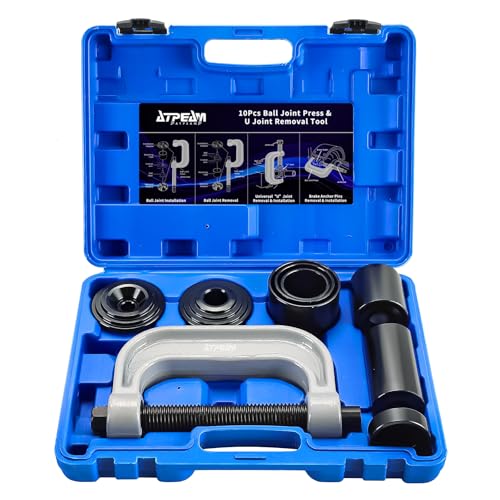
- Premium Quality: This ball joint tool kit is made of solid carbon steel with anti-rust finish, perfect for removal/installation of press-fit parts, such as ball joints, universal joint and truck brake anchor pins.
- Easy To Use: It will help you effortlessly remove press fit parts including ball joints, U-joints, brake anchor pins without removing the control arm from the vehicle. Besides, this tool kit can also remove rusted and corroded parts. Really save your energy and time in daily life.
- Package Included: 3x Receiving Tubes, 1x Removal Adapter, 1x Installation Adapter, 1x Screw, 1x Install Cup Adapter, 1x Forcing-screw Press, 1x Receiving Cup, 1x Installing Cup.
- Wide Application: The heavy duty 4-wheel drive ball joint tool is compatible with most American domestic and imported 2-wheel drive (2WD) and 4-wheel drive (4WD) cars. It allows service for 1/2 and 3/4 ton 4WD vehicles
- Blow Storage Case: The Ball Joint Press set is packed in a heavy-duty, storage case with precision-sized compartments for every piece - great for storage and transport while lengthening the life of the tool set.

- Gearwrench's Ball Joint Separator is made for separating the ball joint from the spindle support arm on domestic and import front wheel drive vehicles
- Adjustable for different size ball joints
- Suitable for most cars and light trucks (not intended for use on 3/4 ton or 1 ton trucks)
- Works on ball joints from 1-1/8” to 2-1/8” and 30 to 56mm in size
- Slot is 7/8" wide by 1-1/4" Deep


- 1, EASY OPERATION: The ORION MOTOR TECH Ball Joint Press Set with 4x4 Adapters effortlessly removes press-fit parts including ball joints, U-joints, brake anchor pins, and more on most 2-wheel drive (2WD) and 4-wheel drive (4WD) vehicles without removing the control arm.
- 2, UNIVERSAL COMPATIBILITY: Fits most American domestic and imported cars and light pickup trucks with press-fit type ball joints. Includes a 4WD adapter for service on 1967 - current 1/2 and 3/4 ton 4WD vehicles with the Dana 30 or 44 front axle (found on Ford, GM, Dodge, IHC, and Jeep vehicles).
- 3, PROFESSIONAL-GRADE DURABILITY: Constructed from heavy-duty forged steel with black-oxide finished adapters for maximum strength and longevity that resists rust and corrosion to endure years of heavy use.
- 4, ALL-IN-ONE TOOL SET: 3x Receiving Tubes, 1x Removal Adapter, 1x Installation Adapter, 1x Screw, 1x Install Cup Adapter, 1x Forcing-screw Press, 1x Receiving Cup, 1x Installing Cup.
- 5,PROTECTIVE CARRYING CASE: Each component is contained in a heavy-duty plastic carrying case with a handle for safe storage and quick organization. If you are not satisfied with this product or if you have any questions, please feel free to let us know.

- EASY OPERATION: Use the ORION MOTOR TECH Ball Joint Press Tool Set with 4WD Adapter to effortlessly remove press-fit parts including ball joints, U-joints, brake anchor pins, and more on most 2-wheel drive (2WD) and 4-wheel drive (4WD) vehicles without removing the control arm.
- UNIVERSAL COMPATIBILITY: Fits most American domestic and imported cars and light pickup trucks with press-fit type ball joints. Includes a 4WD adapter for service on 1967 - current 1/2 and 3/4 ton 4WD vehicles with the Dana 30 or 44 front axle (found on Ford, GM, Dodge, IHC, and Jeep vehicles).
- PROFESSIONAL-GRADE DURABILITY: Constructed from heavy-duty forged steel with black-oxide finished adapters for maximum strength and longevity that resists rust and corrosion to endure years of heavy use.
- ALL-IN-ONE TOOL KIT: 3x Receiving Tubes, 1x Removal Adapter, 1x Installation Adapter, 1x Screw, 1x Install Cup Adapter, 1x Forcing-screw Press, 1x Receiving Cup, 1x Installing Cup.
- PROTECTIVE CARRYING CASE: Each component is contained in a heavy-duty plastic carrying case with a handle for safe storage and quick organization.
This product presentation was made with AAWP plugin.